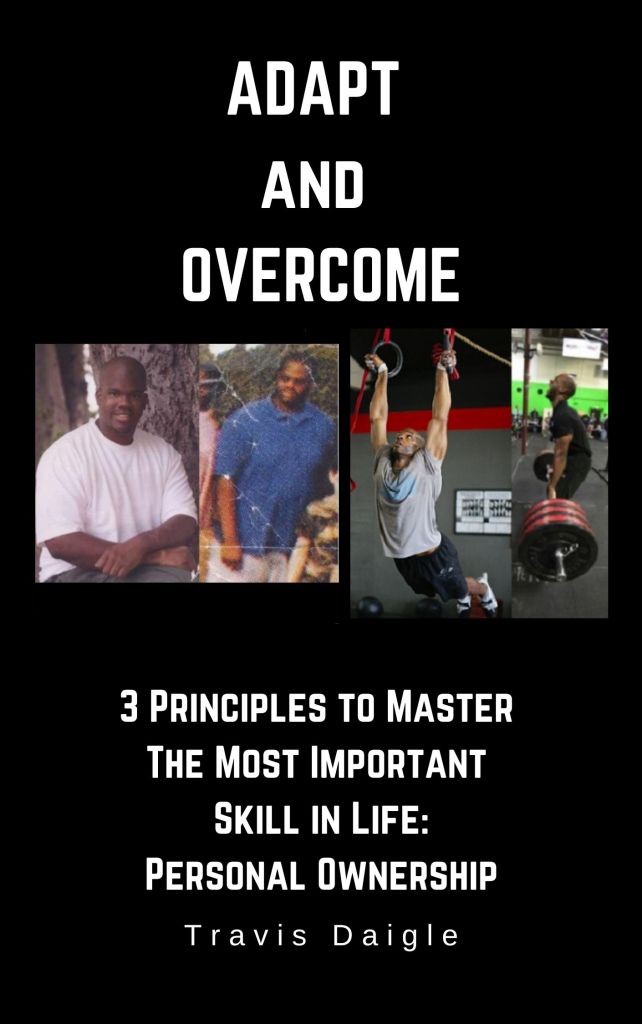
Why write a book on Personal Ownership?
Losing 100 lbs and Keeping it off…
Earning an Electrical Engineering Degree and Graduating with honors as the first member of my family to finish college…
Paying off $60,000 dollars of student loans, credit cards, and a repoed car while navigating the training to become a US Army Green Beret…
These are the 3 major evolution’s in my personal life that have influenced my fundamental philosophy on self improvement. That philosophy is anchored in the idea that Personal Ownership is the most important skill in life. In my book I define personal ownership as taking responsibility for your actions, beliefs, and overall direction in life.
There are several animating reasons that lead be to this belief and writing this book:
- The COVID-19 Pandemic shut the world down. Being so limited in what we could do at the time I figured that this would be a great chance to write a book. This is important because I had several significant speaking opportunities canceled. Opportunities that could have led to much more notoriety. It was disappointing but I decided to stay focused on what I could control.
- As I wrote my story, I looked for the throughline. As a speaker I had told so many of these stories and pulled out specific ideas or principles appropriate to the audience, but as I zoomed in and out on my life, I realized the the key task in moving forward and feeling a sense of personal growth was taking ownership of my situation and the problems in front of me. “Take Ownership!”, has been said a million times in a million ways but I wanted to deliver a more tangible meaning and matrix for organizing our problems and that’s where these three principles of ownership came to fruition.
- Finally, as the pandemic unfolded we all saw how divided the country appeared to be. I believe we should all have the ability to voice our genuine thoughts on social issues. However, in this time frame there has been an aggressive emotional component to the energy that drives many people’s cultural/political beliefs. At its best it feels dismissive of any other viewpoint and at its worst it makes alternative viewpoints seem like that of a dangerous enemy that needs to be confronted with violence of some sort (Americans vs. Americans?). It has been my personal experience that anger and being dismissive of others is often an effort to avoid personal responsibility for tactfully communicating my own viewpoint and an unwillingness to acknowledge alternative viewpoints. Said more simply, how can I expect someone to hear and understand me when I’m screaming, shouting, and presenting an aggressive physical stance. Communication is what the other person hears, as they say.
In all the fiery rhetoric on both sides of the political aisle, the justification of destroying property in both the protests over George Floyd’s death, and the Jan. 6th Capitol Riot, I see individuals who have great concern for themselves, their families, and their communities. However, accelerating that concern to anger, property destruction, and violence I believe is partially the result of not taking the time to do deep personal introspection and communicate concern with empathy. Personal Ownership is what leads to this kind of inspection of self. It has become too in vogue to criticize the system for what we believe are the shortcomings of our own existence. I believe we should criticize systems but I also believe we should do everything within our power to transcend obstacles because there will never be a perfect system.
The Hardest Thing We Do In Life
“Why is personal ownership the most important skill? I also believe that the greatest temptation in life is to blame something or someone, outside ourselves, when dealing with a situation that requires us to change ourselves in some way. Blame can also be directed inwardly as we become frustrated with ourselves for the mistakes we make on the road to change. Neither is helpful as neither helps us focus on problem solving. Change of any kind is the hardest thing we do in life as change is often associated with adversity. However, if we are willing to resist the temptation to blame and take ownership by engaging the adversity associated with change, then I think we can experience a greater sense of meaning and personal growth.”
-From pg. 1 of my book
For the sake of clarity I want to reference my 2018 TEDxTacoma Talk:
I think we need to understand that pain, difficulty, and suffering come in many different forms and these things are a permanent feature of human existence. The argument I make in the talk is that we can choose who we become as a result of pain. Significant change will usually involve significant adversity (or pain).
When we have to change our mindset and habits to get healthy…
When we have to change our mindset and habits to deal with a Global Pandemic…
When we have to change our mindset and habits to deal lovingly with a family member who is going through difficult times…
The goal should never be avoiding change (or pain). The goal should be doing the work to meet whatever change/pain/adversity we experience on the road to our vision for the future with the determination to adapt to, and overcome challenges. We would rather navigate intentionally in a direction of our own choosing as we experience waves of change rather than being tossed around randomly by waves of change.
What Now?
Get a journal and start writing.
Anyone that I coach 1-on-1 or in small groups must write. Learning to write clearly and honestly with a measure of brevity has led to many breakthroughs in understanding my own behavior. It’s the writing and editing that helps you see yourself.
Principles work if you work them! Writing is a huge part of how you work them!
Let me ask you a question:
Think about the pandemic and the changes in daily life you had to make in response to factors beyond your control.
- Where did you live before, during, and after the pandemic?
- What were your romantic, familial, and friendly relationships like during this time? Were you working, a student, or both/neither? If you were working/in school, were you thriving? Why or why not?
- How was your health during the pandemic?
- How were your finances and what was your sense of financial wellbeing in this period?
- Was there a specific part of the many cultural upheavals that bothered you during the pandemic? Why?
Be as detailed as you can. This exercise is about learning how to look at our behavior in greater context with our environment both physically and mentally. No one exists in a vacuum and ownership is about awareness of self in relationship to the environment. The only wrong answer is not doing the work to answer the questions! It works if you work it!
Discover more from Travis Daigle
Subscribe to get the latest posts sent to your email.
 Travis Daigle